
Everyone is talking about AI. And specifically, everyone is talking about giving users the ability to just ask the data a question and get an answer in seconds.
On one side of that conversation sits the enthusiast, the early adopters, the executives who saw the demo and sent the Slack message the next morning. On the other side sits the conservative. Not because they dislike the idea. But because they know something the enthusiast hasn’t fully reckoned with yet.
The data isn’t ready.
And here’s what nobody wants to say out loud: the data will never be 100% ready. But there is a maturity level your organization has to reach before any of the AI promises become real and most companies are further behind on it than they think.
That maturity level has nothing to do with which AI tool you pick. It has everything to do with where your business logic lives.
What Most are Doing and Nobody is Talking
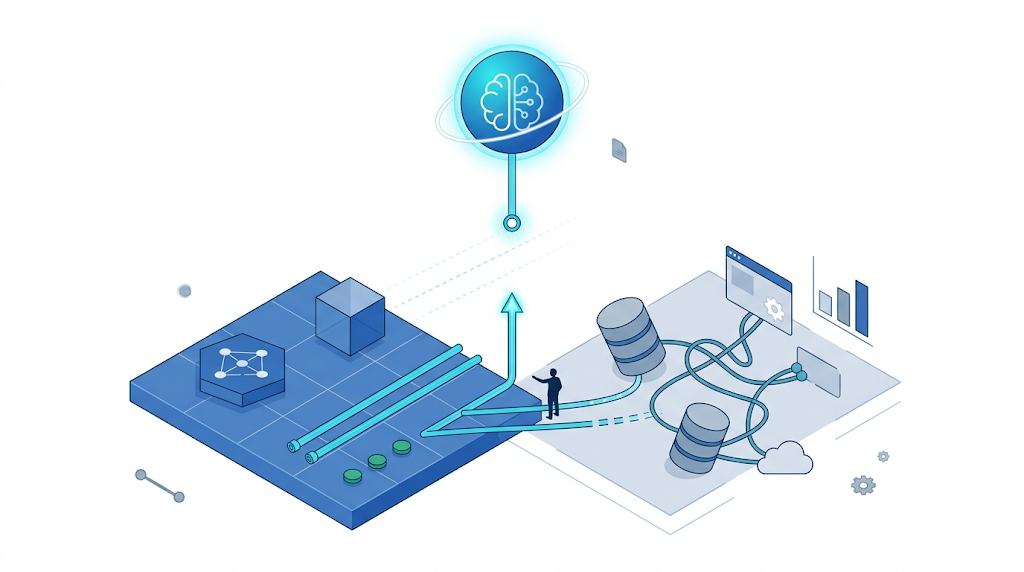
Over the last five to ten years, something important has been happening quietly across the data world. The companies that are furthest ahead on analytics and now on AI have been making the same structural move: pulling all business logic out of their front-end applications and BI tools and centralizing it at the data platform layer.
It’s not glamorous work. It doesn’t come with a product launch or a conference keynote. But roughly 80% of the organizations we’ve worked with and spoken to in the last few years are doing exactly this, or actively moving in that direction.
The principle is simple: the visualization layer should only consume results. It should receive answers, not generate them. Your BI tools should render what the data platform already knows, not apply rules, transform data, or hold logic that only the person who built the report fully understands.
When the logic lives in the BI layer, you are one developer departure, one tool migration, or one platform retirement away from losing institutional knowledge that took years to build.
Lesson Nobody Forgot
If you’ve been in the data industry long enough, you remember when QlikView changed everything.
The in-memory engine was revolutionary. Data teams didn’t need IT anymore, they had everything they needed at hand. Changes were fast and immediate. You could pull in external sources, apply heavy transformations, and embed complex business logic directly into the application. It felt like complete freedom.
It came with a price.
That logic went everywhere. Hidden inside scripts, inside variables, inside chart expressions that only the person who wrote them could fully trace. The application became the documentation. The developer became the dependency.
Then Qlik decided to retire the product and move to their cloud platform.
That was years ago. There are still companies today (serious companies, enterprise environments) running QlikView as the backbone of their results and business reporting. Not because the tool is optimal. Because the business logic is buried so deep inside it that migration feels more dangerous than staying.
They are not trapped by a BI tool. They are trapped by a decision made a decade ago to put the logic in the wrong place.
Power BI, Tableau, and the new generation of platforms arrived and the market moved fast. The tools got better, web interfaces, responsive design, self-service capabilities, smoother everything. Companies saw the movement and wanted in. And not always because their current tool was failing them. Sometimes because the market is loud, the deals are good, and missing the next wave feels like falling behind.
This is the fear of missing out applied to data infrastructure. And it has left a significant number of organizations running two, three, or four platforms simultaneously, each one carrying fragments of business logic that nobody has fully mapped, and migration projects that can never quite finish because untangling one environment means finding logic you didn’t know was there.
The Shift That Matters
You start by changing where the logic lives.
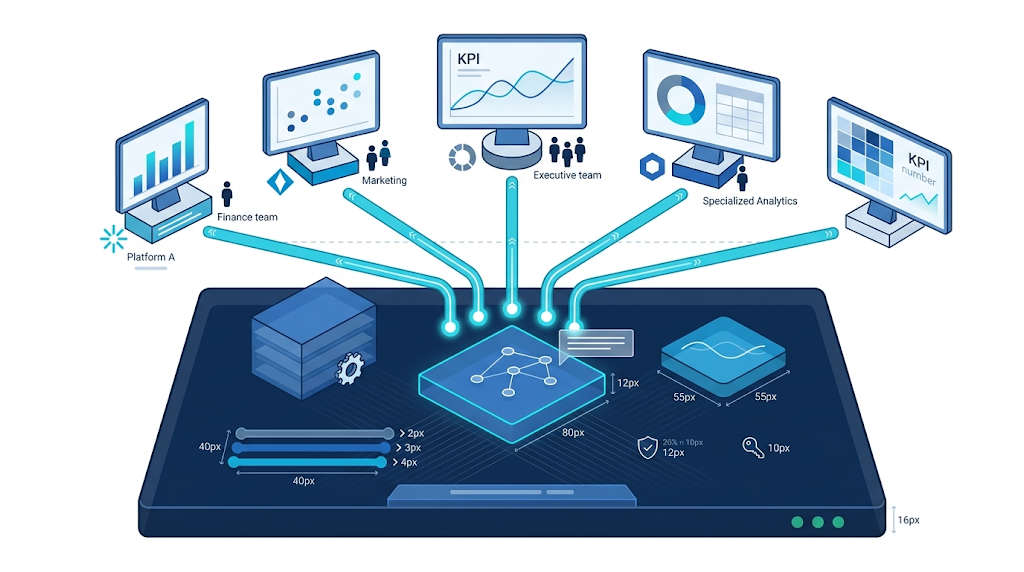
When you move your business logic to a centralized data platform: your warehouse, your semantic layer, your single source of truth, something changes structurally. The data sits in one governed place. The rules are applied once, consistently, by people whose job is to maintain them. When something needs to change, it changes in one place and every tool downstream reflects it immediately.
And then something else becomes possible.
If the logic doesn’t live in the BI tool, you are free to choose the BI tool based on its strengths rather than its ability to hold your data hostage. Finance can use what Finance does best in. Marketing can use what fits their workflow. Operations can use what the technical team prefers. The decision is no longer about which single platform everyone will tolerate, it becomes about which tool serves each team most effectively.
Multiple BI platforms stop being a governance problem and start being a legitimate strategy.
Your data team stops maintaining fragmented logic across five different environments and starts building on a foundation that actually scales.
And when someone asks whether you’re AI ready (whether your users can query the data in natural language and receive reliable, consistent answers) you have something real to point to. Not a demo. Not a pilot. A data architecture that is prepared for what comes next.
The Last Piece
There is one thing the centralized logic approach doesn’t automatically solve.
When multiple BI tools are running in parallel, each one serving a different team, each one connected to the same clean data foundation, your users still need to find what they need. They still need to know where to look. They still need a coherent, organized, trustworthy place to access everything.
The data layer is unified. The experience layer often isn’t.
The organizations that complete this journey build one more thing on top of the foundation: a single access point. One place where every user, regardless of which BI tool is running underneath, can log in once, find what they need in seconds, and trust that the environment they’re navigating reflects the organization that built it. Branded, organized, and consistent.
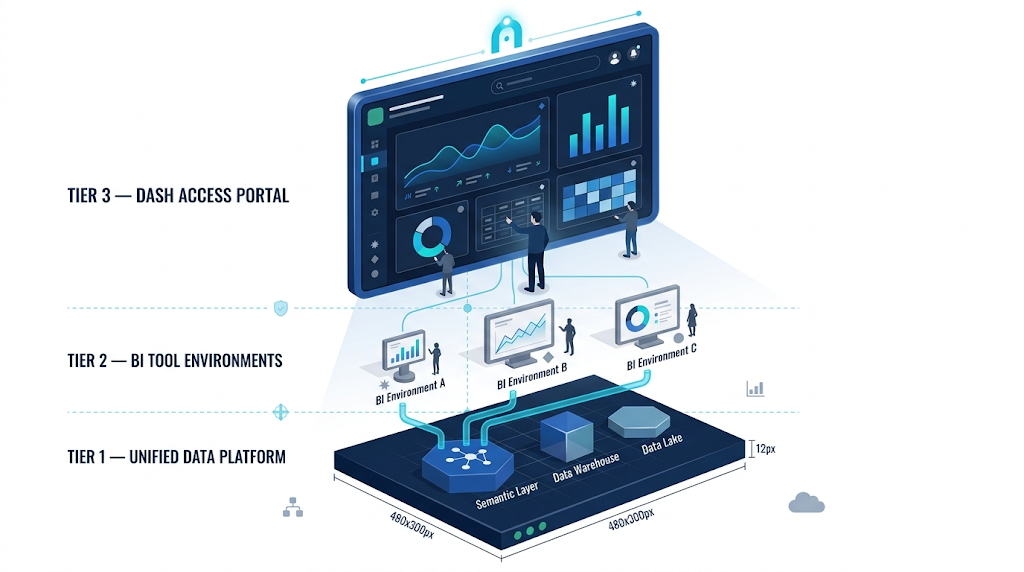
When that access layer exists, everything works together. The governance investment pays off. The multi-platform strategy becomes a strength instead of a confusion. The AI layer has something coherent to sit on top of.
If you’re seeing this shift happen in your industry and you’re trying to figure out where to start (whether it’s moving the logic out of your BI tools, rationalizing a multi-platform environment, or thinking seriously about AI readiness) this is the moment to act.
The companies that get this right in the next two years will be operating at a pace that makes the current conversation about AI feel like it was always inevitable.
The ones that don’t will still be explaining why the migration never finished.
We’ve Lived This From Both Sides
Everything we’ve described here came from real conversations. Not analyst reports or conference panels, from data managers at the end of their patience, CTOs carrying the weight of migrations that never finished, and data teams that are exhausted.
Those conversations always land in the same place: the problem is clear. The path forward isn’t.
Because solving this completely requires two things that most organizations are trying to find separately.
The first is the data foundation itself: the architectural work of pulling logic out of fragmented BI environments and centralizing it where it belongs. That’s not a product you buy. It’s a journey, and it requires people who have actually done it, who know where the hidden logic hides, who understand what a QlikView migration looks like from the inside and what it takes to move an organization from technical debt to a genuine single source of truth.
The second is what sits on top of that foundation: the access layer that makes the whole thing usable. The single front door that lets every user find what they need in seconds, regardless of which BI tools are running underneath. Branded, organized, and built to absorb the complexity so users never feel it.
We’ve been working on both sides of this problem. The data architecture work, the warehouse migrations, the semantic layer builds, the logic centralization projects, that’s where we started. That’s the work that taught us what was missing at the top.
And what was missing at the top is what we’ve been building.
If what you’ve read in this article describes where your organization is right now, logic scattered across BI tools, a multi-platform environment with no coherent front door, an AI roadmap that keeps getting blocked by data readiness questions, we can talk.