
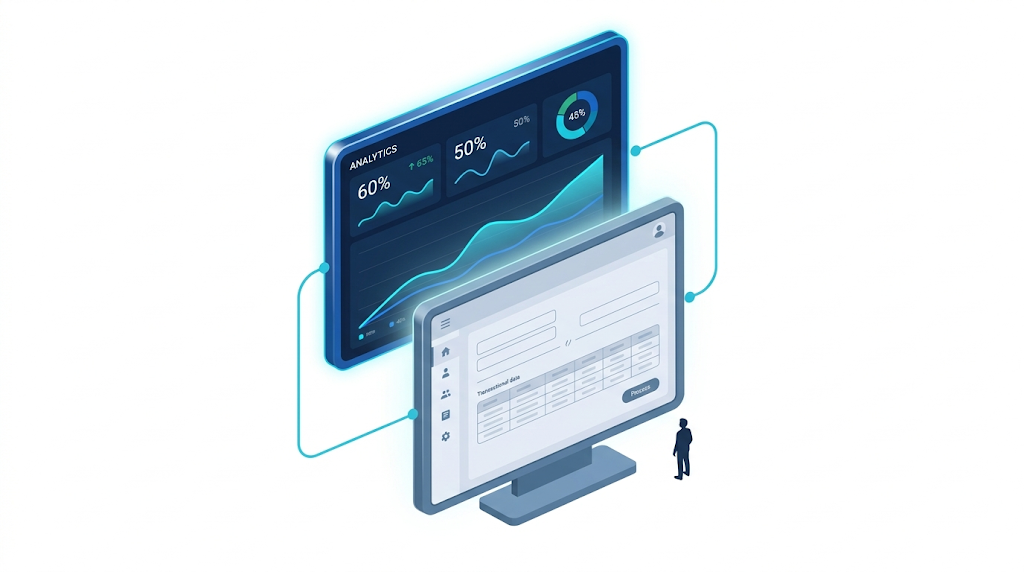
Software and Data: Strategic partner in revenue growth
We worked for several years with companies that build systems. Systems for customer care, CRMs, call centers, facility management, payments, invoicing. All kinds of systems.
Their software solved a real, fragmented pain their customers had: the daily transactional interactions with their end-users. They created organized interfaces with workflows that saved hours and hours of manual work. Real problems, real solutions.
So why were we working with them?
They didn’t sell data. They didn’t sell dashboards. They sold software that solved a transactional pain. The system was the product. The workflows were the value proposition. The front-end was meticulously designed to help a finance analyst enter invoice information and get their revenue tracked on time.
But here’s what we learned, over and over again, across multiple customers.
The number one driver that helped them close sales wasn’t their newest feature. It wasn’t how fast they could fill in forms and push them through a workflow. It wasn’t the sleek interface or the seamless user experience.
It was the dashboards that came with it.
Very boring, very traditional charts and tables. Sometimes just a few numbers on top. The good old reporting. Nothing flashy. Nothing innovative. Just data, organized and visible.
And it drove more sales on its own than the software alone.
Customers were impressed by the system. They needed it. It would solve real problems in their daily operations. But the cherry on top, the thing that made them lean forward in the demo, was the dashboards. The charts. The trends. And the famous question that every person in this industry has heard at least once:
“Can I export this to Excel?”
Sometimes the deal would only close after the dashboard was presented. Not the workflow. Not the automation. The dashboard.
Think about that for a second.
The Last to Know
Changes in the system. New fields. New features. New workflows. The engineering team ships them. Product celebrates. Marketing updates the website.
And the data team that built the reports and dashboards, the ones that are the number one reason customers decided to buy? They weren’t involved. They were always the last to know. Sometimes they only found out when something broke. Charts showing weird numbers. An error page where a report used to be.
The customer calls customer success: “Where can I see the data from the new feature?”
Then the data team gets involved. “Oh, we forgot to tell you. There are new fields and features that you need to incorporate.”
The number one reason your customers buy your tool. And you let the team that builds it find out last.
And then the pressure. Be precise. Be right. Get it fixed. Fast. Because the customer already paid for this.
We’ve seen this play out in company after company. We worked in some of them. We helped them build the foundation, the data modeling, the dashboards. And even while we were running against the clock to incorporate the latest changes, the next feature would already be shipping. And the product team didn’t want to wait.
Technical Debit
And I haven’t even mentioned the other part.
The part where the data team has to fix in the reporting layer what the software couldn’t do. Fill in gaps in the numbers. Create data flows that calculate metrics on the fly because the engineering team that had all the time in the world to build and ship a feature didn’t get the data model right. They didn’t talk to the data team before shipping. They didn’t think about how the numbers would look downstream.
So the data team becomes the cleanup crew. Patching logic. Reconciling mismatches. Making sure the dashboard still tells a story that makes sense, even when the underlying system changed overnight without warning.
This is what happens in hundreds of companies. We know a few. We worked in some of them. The pattern is always the same.
Pressure Versus Value
This is the real reason the data team is simultaneously the most valuable group in your organization and the most broken.
Not because the challenges are impossible. Not because the tools aren’t good enough. Not because the people aren’t talented.
Because the data team is treated as a cost center. A ticket queue. A team that gets looped in after the decisions are made, after the features are shipped, after the customer is already asking questions nobody prepared them to answer.
They’re not being involved in conversations. They’re not part of feature planning. They’re not in the room when releases are scoped. They are the last to know.
And the pressure is relentless. Because the customer didn’t buy the software for the software.
They bought it for the numbers.
How ironic is that?
The Solution
Here at DexHub, we know these pains. We’ve been through all of them.
After years of watching this pattern repeat, we can tell you with certainty: you will only succeed in this path when you treat your data team as a VALUABLE asset. Not a service desk. Not a cleanup crew. An asset.
1 – Bring Data Team into the conversation earlier.
Build mockups together. Test together. Put software engineers and data engineers in the same room before a single line of code ships.
Ask the questions that matter: after this transaction hits this table, what happens to the underlying relationships that the customer expects to see in the dashboard?
Every new feature has to be aligned with the story your reports are already telling.
2 – Data Team is not a Cost Center
Until your company stops treating the data team as a cost center and a ticket queue, you will carry technical debt that gets fixed on the fly.
You will have high turnover. Nobody wants to work under the pressure of delivering the number one reason customers buy your product while never receiving the credit for it.
Or, at the very least, being involved at the beginning of each conversation.
3 – New Features Versus Maintenance
You need to separate feature work from support. They can’t be the same team.
Your data team working on new features should be shipping hand-in-hand with customer success and software engineering. Together.
A separate support team should take care of what’s already in production, keeping the numbers that are already driving real results reliable and accurate.
We can help you with that.
Your data team is already one of the biggest revenue drivers in your company. Most organizations just haven’t realized it yet.
Imagine what happens when you start treating it that way.
Talk to us about your data challenge
We help you separate feature work from support, building reliable analytics products that drive real results.