
Data is power. We’ve heard it a thousand times.
If you have the right data, process it fast enough, and correlate it with other relevant data points, you create useful information. And useful information drives better decisions.
However, information without a clear direction is useless. A dashboard that nobody trusts. A report that nobody reads. A metric that nobody owns.
Data sits in a very strange place inside most companies.
It uses technology. It consumes infrastructure. It spends money on compute power, just like every other system the company needs to run. Companies invest enormous amounts of time, effort, and money in building the right systems: tracking every order, every hour, every dollar. The right systems can scale a business. The right automation can cut costs and improve revenue.
But where does DATA sit in all of this architecture?
We’ve been in the IT and Data industry for over 20 years. We’ve seen every possible setup. Every structure. Every reporting line. Every flavor of “this is how we organize data here.”
And every single one of them is broken in its own way.
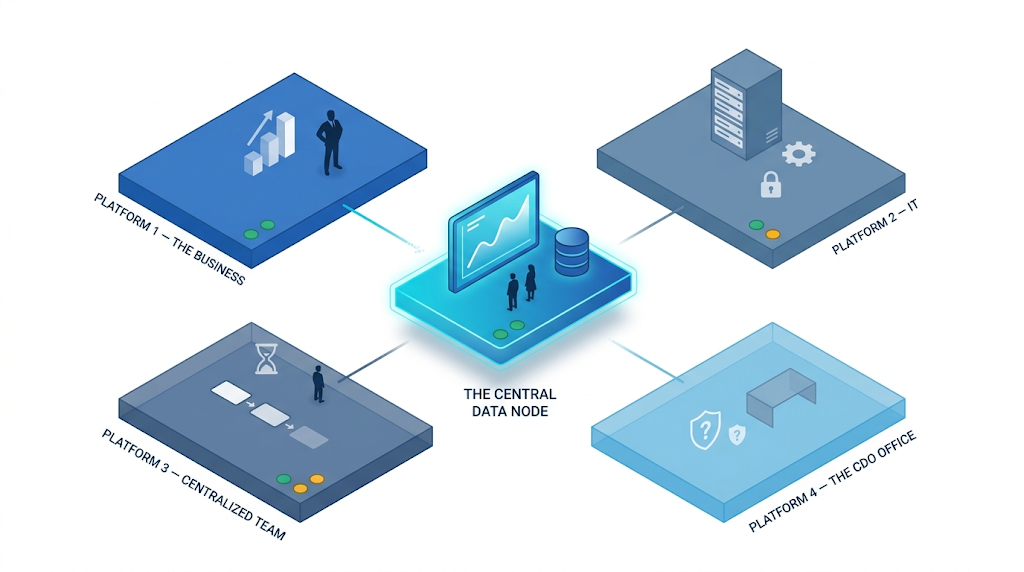
Data Within the Business
If you have a powerful data team sitting next to the business, things move fast. You can speed up the creation, processing, and availability of information for your decisions. You know how much budget you have and what data can deliver. It’s right there, at the next desk. Just request it. You have the authority, the money, and the autonomy to run whatever tools you need.
Sounds great. Flashy, even.
You own the definitions. You own the tool. You own the budget.
But data sitting inside a specific business domain creates silos. And silos cost you harmony, consistency, and visibility into what other areas are doing. Marketing builds one version of the truth. Finance builds another. Operations has a third. We know that embedded data teams often result in duplicated efforts across departments and fragmented governance, with each unit operating under its own standards and processes.
The speed is real. But so is the chaos.
You gain velocity. You lose alignment.
Data Within a Centralized Independent Team
This is the “let’s bring order to the chaos” approach.
All data flows into one team. One backlog. One set of standards. One framework. It works like a fabric: data enters, information gets delivered. Patterns, defaults, consistency.
Beautiful on paper.
But here’s what happens in practice: you become a ticket queue. A data request follows a process. It enters a system. It waits for prioritization. Months later, the business gets their answer, long after the decision it was meant to inform has already been made.
More than half of Chief Data Officers serve less than three years in the role. They come in with a mandate to centralize, organize, and standardize. Many leave before the transformation is finished. The business moves on. The centralized team remains, perceived as a barrier.
You create harmony. You lose speed.
Centralized data teams are almost always seen as cost centers. You own the processes, but not the data and not the definitions. The tool? You can own its complexity and organization, sure. But who pays for it? Still the business. You have no authority. You have no budget of your own. You are, in the eyes of the organization, only a cost.
Data Within IT
This one could be the holy grail. At least, that’s how it looks at first.
You’re closer to where the systems are delivered. Every schema change would be meticulously communicated. You’d have advance warning to test your dashboards. Your information would never break. Everything in one system. No silos.
But it’s actually worse.
You don’t own the data. You don’t own the definitions. You inherit IT’s entire landscape of processes, and none of them were designed with data decisions in mind. You add another layer of bureaucracy on top of the bureaucracy IT is already known for. The prioritization cycles. The change management. The approval chains.
You are so far from the Business that data decisions, which should be fast and dynamic, are now treated like long waterfall projects. You still don’t have a budget. You still don’t have authority. You still don’t have autonomy.
You gain organization. Clean processes. Flawless structure.
You lose everything else.
The CDO Paradox
And then someone invents the Chief Data Officer role, because surely that will fix everything.
Let’s think about what a CDO actually owns in most organizations:
They don’t own the data. The business owns the data.
They don’t own the tools. IT or the business controls the tools.
They don’t own the definitions. Each department defines its own metrics.
There is no real autonomy. There is no dedicated budget. There is no independent authority.
What’s left? Process. Bureaucracy. And a job description that says “be accountable for the data” without giving you any of the levers to actually control it.
85% of organizations now have a CDO or CDAO, up from just 12% in 2012. Yet CDO tenure remains alarmingly short, with nearly a quarter lasting less than two years. This isn’t a people problem. It’s a structural one.
The CDO role, in many organizations, is designed to fail.
The Accountability Trap
We’ve lived this, and we’ve watched dozens of companies live it too.
Think about the four scenarios a data team faces:
The data is correct and shows positive results. The business takes credit. They’re on track. The data team? You did your basic job showing a number on a screen. Nothing special.
The data is correct and shows bad results. Now it’s your fault. Your processes, your tools, your pipelines. Nobody trusts the numbers
The data is incorrect and shows positive results. Nobody questions good news. The business celebrates. But you’ll discover the error eventually, and when you do, it’s yours to explain.
The data is incorrect and shows bad results. Nobody will ever trust you again.
In every scenario, the data team loses.
Many business leaders suffer from “decision distress,” yet they often make decisions first and look for data to justify them afterward. Half of executives ignores computer-generated data because it contradicted their own intuition.
So what actually happens?
The CEO makes decisions on gut feeling. The CFO runs the budget off the Budget_2026_v10.xlsx, shared by email. Marketing makes their calls from Google Sheets. Operations presents extracted PowerPoints from the ERP.
Two-thirds of CEOs still rely on gut feel when making decisions, and executives believe their instinct is what sets their decisions apart.
Your data team’s work? Somewhere in the background. Important in theory. Invisible in practice.
Data Industry
We’ve seen trends come and go in this industry. Self-service BI, big data, data lakes, data mesh, augmented analytics, generative AI. Each wave promised to solve “the data problem.”
None of them addressed where data sits. None of them addressed who owns the accountability.
The data team is one of the most important groups in any organization. And it’s been treated like a shiny Christmas gift: exciting on the evening you unwrap it, forgotten three months later when the birthday presents arrive.
It’s important. Everyone agrees. And yet, nobody wants the full responsibility that comes with it.
Let’s be honest about what each setup actually delivers:
Data with the Business. Fast decisions. No centralization, but you have money and authority.
Data within IT. Forget fast decisions. You own the tool and its complex license model, but you don’t own the data, you don’t own the definitions, and you have neither money nor authority.
Data as its own vertical. A mix of worlds. You own the process. You’re not as slow as IT. But you still don’t own the data. You have very low authority. And you have no money.
The more you navigate this landscape, the clearer a few truths become.
The business is responsible for its data and its definitions. And it should be held accountable when things get out of hand. Data is powerful, and yet it remains one of the most complex layers of any business. Nobody wants to be the owner of a bad result. Or even the owner of bad data.
Your work as a data expert can be traced back to one of the setups described above. And yet data remains the most important piece of the puzzle.
What We Believe
At DexHub, we believe data should not be treated as a cost center. It should be treated as a business center, delivering data as products.
With process. With authority. With budget.
You can create data assets that serve the business internally and even externally. You can transform the rigid, complex processes of IT into fast, intuitive, dynamic, and flexible workflows. You can solve business problems quickly with the organization and discipline of a centralized team, without the speed penalty.
Data should be treated as its own department. One that owns the processes, owns the data, owns the definitions and most important, Business has to be involved in the accountability, for good results and bad ones alike.
Data should choose the best tool for each scenario. Let the tools deliver what they do best. And then focus on the layer that actually makes or breaks adoption: the Access Experience. Decrease the complexity. Increase the clarity.
Where does data sit in your organization?
And more importantly: is anyone truly accountable for it?
Talk to us about your data challenge
We help you separate feature work from support, building reliable analytics products that drive real results.